Staunton Hill
Charlotte County [Virginia]
By Louise Este Bruce. [c. 1923]
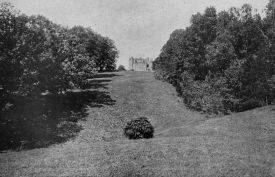 Staunton Hill is situated in Charlotte County, about forty miles
southeast of Lynchburg, on the Staunton, really the Roanoke River,
for the latter, as John Randolph of Roanoke once said, passes for a
considerable distance incog., under the name of the
Staunton.
Staunton Hill is situated in Charlotte County, about forty miles
southeast of Lynchburg, on the Staunton, really the Roanoke River,
for the latter, as John Randolph of Roanoke once said, passes for a
considerable distance incog., under the name of the
Staunton.
The tract of some six hundred acres, on which the Staunton Hill
mansion stands, was acquired by James Bruce, in 1803, and was
afterwards enlarged by purchases of adjoining lands, made from
time to time, by James Bruce and his son, Charles. The former
resided at Woodbyrn, in Halifax County, and it was not until 1848
that the house at Staunton Hill was erected by Charles Bruce, on
the six-hundred-acre tract just mentioned. This, with the addition
made to it by James and Charles Bruce, in 1896, the year of the
latter's death, amounted to five thousand and fifty-two acres.
The mansion is built in the Gothic style of architecture of stuccoed
brick with towers and battlements. The front porch is constructed of
marble, which was imported from Italy to Philadelphia. After being
reduced to the proper shapes there, it was conveyed by sea to
Albemarle Sound, and thence by bateaux up the Roanoke River to
the Staunton Hill estate.
One of the most striking features of the house is the well-nigh
perfect proportion of its external details. Extending back from the
rear there is a colonnade about two hundred feet long. The roof of
this is supported by iron pillars painted white, and the floor is flagged
with large granite blocks. Along it are ranged the kitchen, laundry
and service quarters. From the west side of the house projects a
conservatory, and a short distance to the southwest of this is a
Gothic outbuilding of five rooms. This is known as the office, where
the business of the plantation, which was worked in three shifts by a
large force of hands under three overseers, was usually transacted.
The mansion contains twenty-five rooms, three of which — the front
drawing-room, the center drawing-room and the library — constitute
a suite of rooms which in point of design, finish and space would
compare favorably, if not more than favorable, with any similar suite
in any of the conspicuous homes of the Virginia past. The library,
which is a truly beautiful Gothic room, is furnished with a fine
collection of standard books, mainly purchased by Charles Bruce in
London in or about the year 1848. One of the most attractive
features of the house is its vestibule, with a floor of black and white
marble, and supplied with niches filled with classic figures.
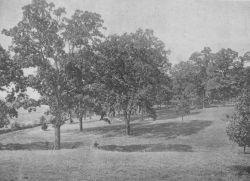 The grounds and flower gardens are about eight acres in area and
were laid out by a Mr. Kirk, a Scotch landscape gardner, at or about
the time the residence was built. Under his supervision, the
grounds were adorned with many varieties of trees, native and
exotic, such as the ash, the beech, the deodar, the cedar of
Lebanon, and other species of domestic and foreign trees too
numerous to mention. Scattered among these are clumps of
shrubbery. As the original plantings have succumbed to the
ravages of time, they have been renewed with the same
painstaking care that marked their origin.
The grounds and flower gardens are about eight acres in area and
were laid out by a Mr. Kirk, a Scotch landscape gardner, at or about
the time the residence was built. Under his supervision, the
grounds were adorned with many varieties of trees, native and
exotic, such as the ash, the beech, the deodar, the cedar of
Lebanon, and other species of domestic and foreign trees too
numerous to mention. Scattered among these are clumps of
shrubbery. As the original plantings have succumbed to the
ravages of time, they have been renewed with the same
painstaking care that marked their origin.
Equal skill and good judgment were shown by Mr. Kirk in his
scheme of grass plots, roadways and walks, which are fully worthy
of the extensive space over which they are spread. The lower
garden is broken up by a system of judiciously designed grass
walks into many beds of varied shapes. In form, it is semi-circular,
and environing the semi-circle is a dense background of noble oaks
and other forest trees. In this garden a perpetual succession of
roses of different varieties has always been maintained throught the
summer months, to say nothing of many kinds of flowers. In few, if
in any, of the the old gardens of Virginia can be found such a
profuse and brilliant mass of crepe myrtle as this garden displays in
midsummer.
Outside of the house grounds proper are stretches of park-like
woods enclosed by a stone wall between a mile and a half and two
miles long. This was was constructed to a great extent by slave
laborers, as were the mansion and office themselves. A road from
the house, shaded on one side by a dense woods, carpeted with
periwinkle, and on the other by elms and mimosa trees, leads over
to a peaceful little graveyard surrounded by a stone wall covered
with English ivy. In another direction a shaded path strikes off rom
the grounds to a swimming pool. Opposite this, there is a
picturesque walk known as the "Lovers' Walk." This begins in the
park, winds in and out through the forest bounded by the stone wall
and, after many detours, returns to its starting point.
The mansion and some two thousand and thirty acres of the original
Staunton Hall plantation are now owned by William Cabell Bruce, of
Baltimore, the son of Charles Bruce.
This article was published in Edith Dabney Tunis Sale, editor (compiled by The James River Garden Club), Historic Gardens of Virginia, The James River Garden Club, Richmond, VA, 1923.
Return to the home page.
Go to the Architecture Links.
Go to the Bibliography of Design.
Sponsored by Sarah E. Mitchell Information Services: Genealogy and Property Research and Graphic Design.
Direct e-mail to Sarah E. Mitchell.
Web edition copyright © 2002 Sarah E. Mitchell